

Real Madrid are not built for long periods of doubt. Two wins from their last six matches and a four-point gap to Barcelona have pushed Xabi Alonso into territory that feels uncomfortable for a coach only a few months into the job. The defeat at Celta Vigo in particular turned what looked like a slow burn into something sharper and harder to ignore.
The Champions League tie against Manchester City was meant to be Alonso’s coming-of-age night on the biggest stage. Instead, it is being spoken about inside the club as a measure of whether the current project can be trusted or whether it needs a reset.
Reporting in Spain and England has already pointed to tension in the dressing room and to quiet conversations at board level about alternative plans if results do not improve. Even if Alonso survives this spell, those conversations raise a larger issue: who should lead the Kylian Mbappé and Jude Bellingham era from the touchline.
Appointing Alonso in the first place was a decision to go with a young tactician whose main work had been at Bayer Leverkusen rather than with another proven serial winner. Turning away from that idea now would not only be about changing the coach. It would be a choice about what kind of team Real Madrid want to be for the rest of the decade.
Several familiar names are already being mentioned, from club legends to coaches with recent success elsewhere. Some would be short-term stabilisers, others long-term architects. Taken together, they sketch five very different directions Florentino Pérez could choose if he decides to move on from Alonso.
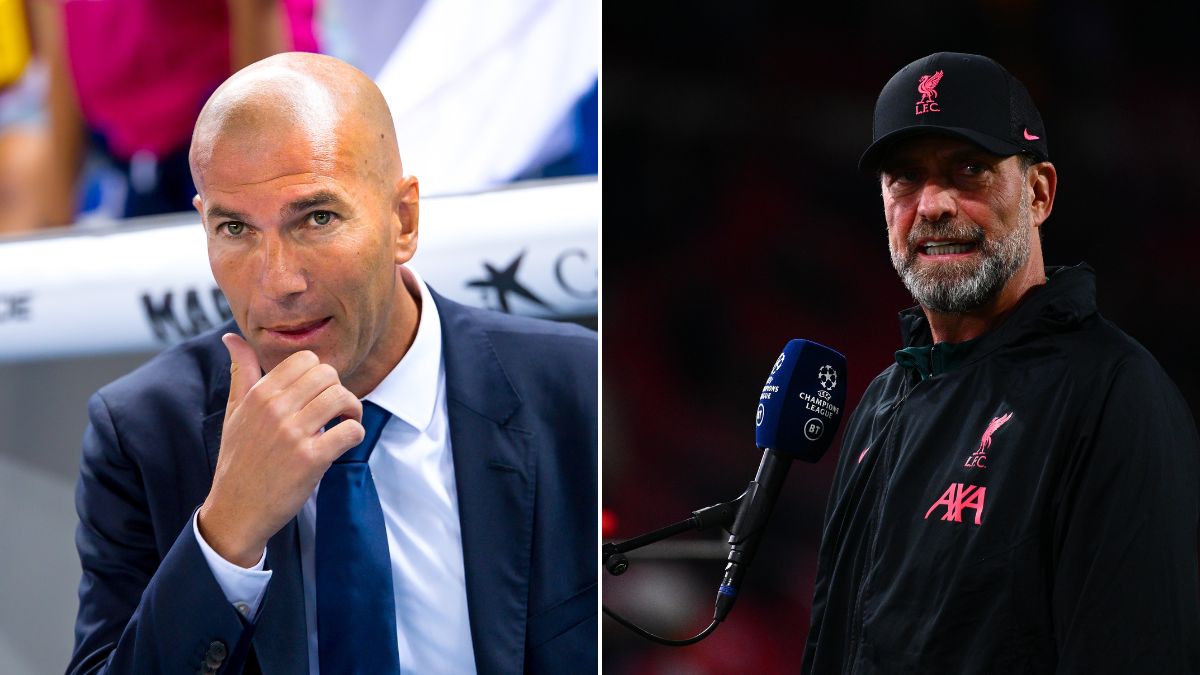
Zinedine Zidane
Zinedine Zidane is the simplest option to understand. His two previous spells on the bench brought three Champions League titles and two La Liga wins. He understands how the Bernabéu works, from the president’s box to the dressing room, and he has already shown he can manage a group full of Ballon d’Or contenders. Bringing him back would calm nerves quickly, and Mbappé would be playing for a coach who shaped this club’s recent European history.
The complication is what Zidane wants next. For years, he has been viewed as the likely successor to Didier Deschamps with France. A return to Madrid now would almost certainly be framed as a temporary arrangement rather than a new multi-year project. The decision for both sides is whether a defined, one-season collaboration is worth the emotional and sporting investment.
Jurgen Klopp
Jurgen Klopp would represent a very different type of change. When he stepped away from Liverpool in 2024 he spoke openly about exhaustion and the need to step back from the grind of daily coaching. Since then he has taken a high-level role in the Red Bull football structure and appeared in long interviews where he sounds more rested than he has in years.
His track record, though, makes clear why his name comes up whenever a giant job opens. At Borussia Dortmund and Liverpool he built teams with a clear identity: intense pressing, quick attacks once the ball is won, and a strong internal culture that pulls star players into the collective. A version of that approach built around Mbappé, Vinícius Júnior and Bellingham is easy to picture.
The problem is timing and appetite. Klopp has given little indication that he is ready to jump straight back into the most demanding club job in Europe. In practical terms he is more of a reference point than an active candidate, the model for the kind of clarity and structure Madrid might look for in whoever comes next.
Oliver Glasner
If Pérez prefers a more understated builder, Oliver Glasner is the name that makes the most sense. At Eintracht Frankfurt, he delivered a Europa League title. At Crystal Palace, he has turned a mid-table squad into a side that looks organised, ambitious, and capable of troubling richer opponents.
Glasner’s teams usually play with a back three, well-rehearsed pressing triggers and clearly defined roles in possession. Players tend to know exactly where they should be when the ball moves. For a Madrid side that has sometimes looked caught between ideas under Alonso, that kind of structure would have obvious appeal.
The question is how his work would scale. Frankfurt and Palace are demanding environments in their own ways, but they are not Real Madrid. Glasner has never had to handle the political noise and constant scrutiny that comes with this job. Appointing him would be a bet that training-ground detail and tactical order can matter more than name recognition.
Andoni Iraola
Andoni Iraola offers a different version of the same principle. He built his reputation at Rayo Vallecano with front-foot football: an aggressive press, quick forward passes and a willingness to commit numbers into wide spaces. At Bournemouth he has adapted that approach to the Premier League, turning them into a team that rarely looks passive, even against stronger opponents.
That style would fit nicely with a forward line built around Mbappé and Vinícius, who both thrive when the ball is won high and space opens up behind a defence. Iraola also knows Spanish football from the inside, which would help him understand the pace of the news cycle and the pressure that comes with managing a club of Madrid’s size.
What he does not yet have is experience at Champions League level or a track record of handling a squad full of superstars. Giving him the job would mean accepting that he is still growing as a coach. For Madrid, choosing Iraola would be a statement that they are prepared to share that learning curve rather than simply hire a finished product.
Roberto De Zerbi
Roberto De Zerbi sits at the far end of the spectrum, the option for a full-scale tactical reset. His work at Sassuolo, Shakhtar Donetsk, Brighton and now Marseille has followed the same broad idea: a team that builds patiently from the back, invites pressure in order to play through it, and fills central spaces with technically secure midfielders who are willing to take risks.
In that sense he would be a fascinating match for a Madrid squad that includes Bellingham, Eduardo Camavinga and Aurélien Tchouameni. De Zerbi’s best teams use players of that profile to control games with the ball and to create passing angles in tight areas, rather than relying purely on transition.
The trade-off is volatility. His approach takes time to install and usually involves a rough first phase in which the team concedes chances and sometimes goals in ways that look avoidable. De Zerbi is also a demanding figure who does not hide his frustrations in public. Hiring him would mean accepting short-term turbulence in exchange for a more clearly defined identity if everything takes hold.
Everyone else
Around the edges of this conversation, other names could become realistic if the timing lines up. Raúl has recently left his role with Castilla after uneven results but still carries enormous weight as a symbol of the club. José Mourinho is working at Benfica under a contract that reportedly includes an exit clause; his recent years have mixed trophies with difficult endings, yet his previous spell in Madrid still resonates with some people around the club.
Simone Inzaghi has moved to Al Hilal, further reinforcing his reputation as a modern specialist in knockout football. Coaches such as Mauricio Pochettino, Julian Nagelsmann and Thomas Tuchel are either between jobs or potentially nearing the end of current cycles. They could enter the picture once international tournaments and domestic seasons shake out, but after this summer.
For now, Alonso remains in place and could still make this conversation feel premature. The next run of matches, and above all the Champions League tie with Manchester City, will do a lot to decide whether that happens. If Pérez does decide to act, the choice will not simply be about who can pick the team on a Saturday. It will be a decision about what Real Madrid want this Mbappé and Bellingham project to become, and how much risk they are willing to accept to get there.
Five coaches who could replace Xabi Alonso at Real Madrid
