

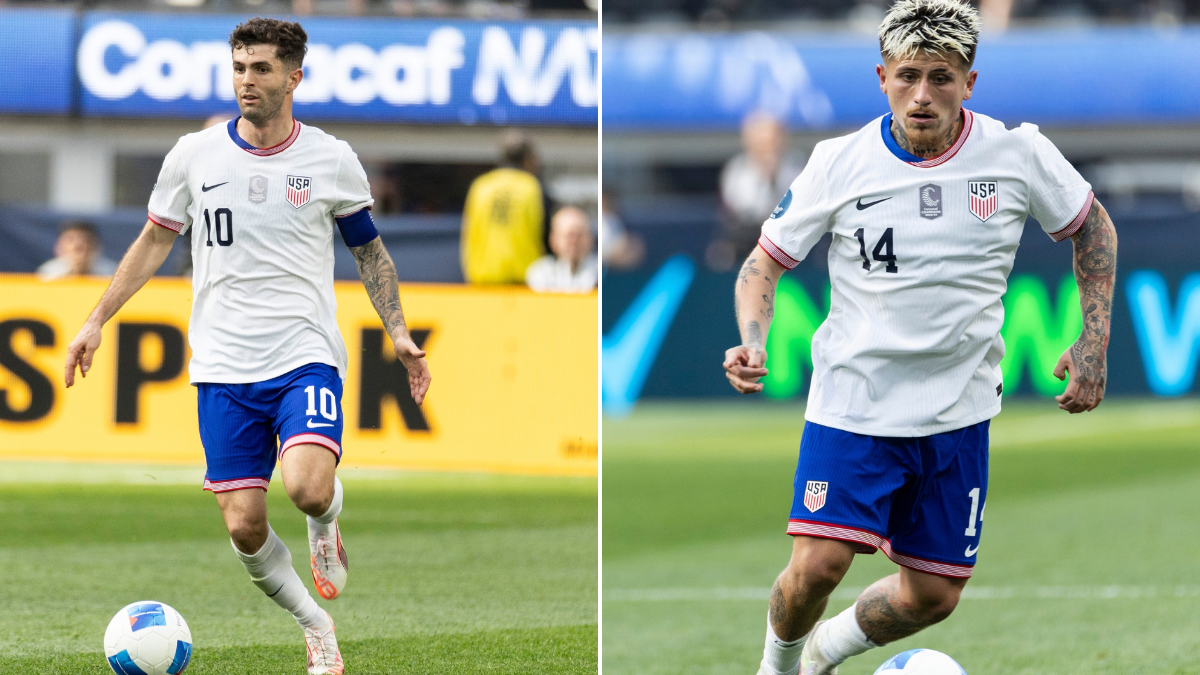
Christian Pulisic has carried the U.S. attack long enough that the No. 10 has started to feel like shorthand. Need a goal, need a burst, need someone to drag the game forward, the ball usually finds him.
Diego Luna is the reason the conversation is shifting. Not because he’s taking anything from Pulisic, but because he’s forcing the U.S. to separate two ideas it has blurred for years: the No. 10 as a jersey, and the No. 10 as a role.
That role is not nostalgia. It’s a grind. The modern “10” has to appear in the crowded places, play quickly in tight windows, and keep showing up even when the opponent is trying to turn every central touch into a foul.
The debate got real during the 2025 Gold Cup, when Pulisic stepped away after a punishing season at AC Milan. Mauricio Pochettino didn’t hide his frustration with the premise of picking and choosing windows, saying, “They cannot dictate the plan.”
Luna took the opening and treated it like a tryout. In the semifinal against Guatemala, he scored twice inside the first 15 minutes and pushed the U.S. into the final with a 2–1 win. Afterward, Pochettino praised him for being “desperate to play,” then delivered the kind of line coaches save for players they trust: “[His] attitude, hunger, desire, everything, and then for sure, the talent will appear.”
Here’s the part that makes this more than a number debate. Pulisic is still the most decisive attacker in the pool. But the version of Pulisic that scares teams most is often the one that starts wide, sees the field, and chooses his moment to cut inside, rather than the one who has to live with his back to goal in the center circle’s shadow.
A setup that lets both breathe
Pochettino’s U.S. has often defended in a 4-2-3-1 and built into a 3-2-5, with Pulisic drifting inside as the main creator. It’s logical. Put your best player closer to goal, and you get more touches where touches matter.
It can also get predictable. When the U.S. runs into a compact block and everything funnels toward the same lane, the star becomes easier to trap. The “role vs shirt” argument, the one you hear every time the game turns static, is really a complaint about that predictability.
A true 10 changes the geometry. If Luna is the connector under the striker, Pulisic doesn’t have to begin every possession in traffic. He can stay wide long enough to pin a fullback, then arrive inside after the defense has already shifted. That timing creates cleaner first touches, more 1v1s, and more of the box entries that separate good attacks from dangerous ones.
It also lets Luna do the unglamorous parts of the job. Check into pockets. Play the wall pass. Turn a loose clearance into a second wave. Press like the ball is personal. Those are the details that travel, especially in tournament games where rhythm is hard to find.
None of this is a demotion for Pulisic. It’s the U.S. acting like a team instead of a highlight reel. If the program is serious about building smarter for 2026, the goal should be to give Pulisic more space and fewer chores. Let Luna connect the game. Let Pulisic attack it. Then judge the idea the only way that matters, by whether the U.S. looks harder to read when the margins shrink at the 2026 World Cup.
