

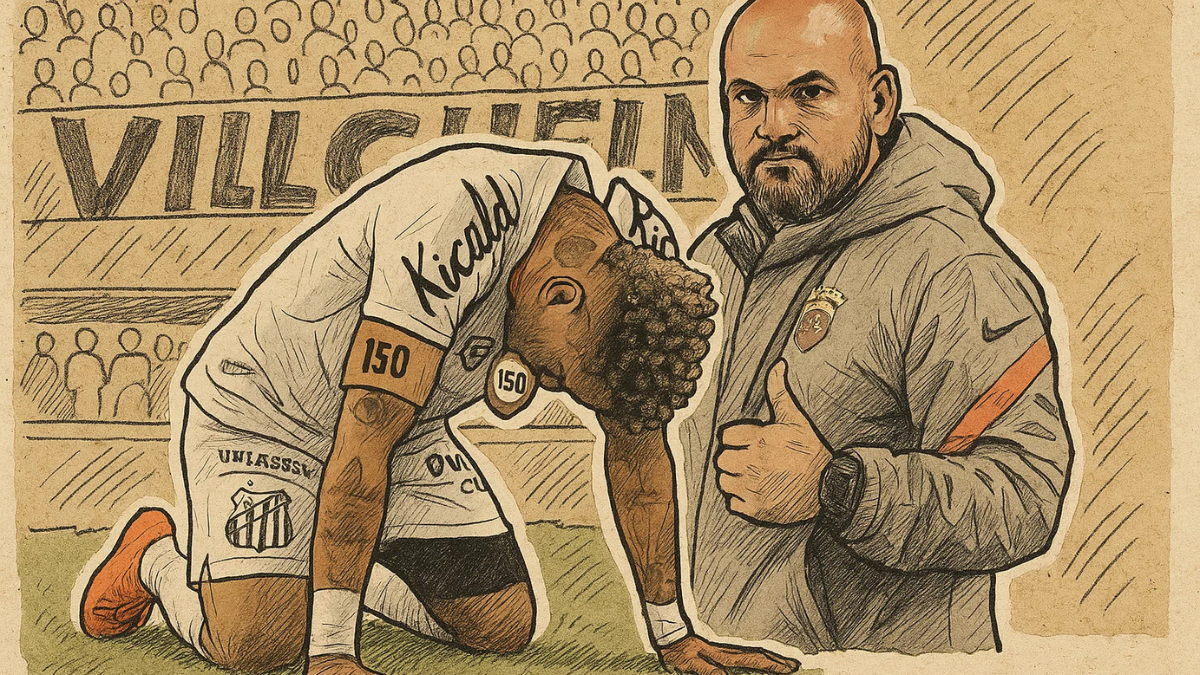
Neymar walked off the Vila Belmiro pitch looking like a man who had finally run out of credit with his own body. He had just dragged Santos to safety in a 3–0 win over Cruzeiro, the last act in a desperate sprint away from relegation that he finished on a torn left knee. He scored five goals in his final four league games, played only 20 of 38 rounds because of injuries, and then told the cameras what everyone could see. There would be surgery. He needed to rest. He still dreamed of being in Brazil’s squad for the 2026 World Cup.
Instead of a quiet off-season, the most daring part of his plan starts now. Alongside a partial arthroscopic meniscectomy on his left knee, Neymar is turning to a Brazilian physiotherapist nicknamed “Dr. Miracle” in the hope that one more specialist can bend the usual rules that govern elite knees.
According to reporting in Brazil and Europe, the 33-year-old will undergo the procedure in the coming days, then work closely with Eduardo Santos, the physio who has built a reputation on getting stars back weeks earlier than expected. Santos is famous enough that a transfer account on X can drop his nickname in quotes and everyone roughly understands the story: Neymar is betting what is left of his Brazil career on a man whose job is to make improbable comebacks look routine.
Hovering over all of this is Carlo Ancelotti. Brazil’s coach said this month that only players who are “100% fit” will make his World Cup squad, naming both Neymar and Vinícius Júnior as examples. If Vinícius is at 90%, Ancelotti insisted, he will pick someone else at 100. He stressed that he does not owe anyone a farewell tournament. If Neymar is in, it will be because he is fully fit and clearly better than the next man in line.
Inside the legend of ‘Dr. Miracle’
Eduardo Santos is not a social-media myth. He is a Brazilian physiotherapist with a degree from the Pontifical Catholic University in Belo Horizonte, plus a master’s and doctorate in sports medicine, and a career that has taken him through Vitesse, Zenit Saint Petersburg and, most prominently, Shanghai SIPG, where he ran the medical department.
The nickname dates back to 2015. While Santos was working for Zenit, David Luiz went down at Paris Saint-Germain with a serious hamstring tear. Early estimates suggested at least eight weeks out. Luiz instead flew to Russia to work with Santos and was back on the pitch within days, a turnaround fast enough for journalists to start writing about a “Miracle Doctor” and for that label to stick.
Since then, a steady stream of high-end players have passed through his hands. Shanghai paid a significant release fee to hire him from Zenit. Hulk, Oscar and Philippe Coutinho have all sought his help, along with more recent Brazil internationals like Matheus Cunha and Vanderson. Santos is currently based in England, where he has been overseeing Fulham forward Rodrigo Muniz’s recovery, and he is widely reported to be flying back to work with Neymar after the meniscus surgery.
Europe has seen him up close too. Manchester United defender Diogo Dalot spent 10 days in Shanghai in 2019 rehabbing a hip problem under Santos’ supervision, another case that generated headlines about the “Miracle Doctor” as the full-back returned earlier than expected. Other clients include Radamel Falcao, Mousa Dembélé and Eliaquim Mangala.
The methods are described as unconventional and extremely intensive, with players living and working around the clock at his facilities. Santos himself pushes back on mystical branding. What he says he offers is science, obsessive attention and a track record of players returning on the front end of their timelines.
Miracles, medicine and the clock
Strip away the nickname and Neymar’s situation is still brutally simple. He has a torn meniscus in a knee that already went through ACL reconstruction and meniscus repair two years ago. He is about to have a partial meniscectomy, a procedure where damaged tissue is removed rather than sewn back together.
For elite athletes, the literature on this surgery paints a wide range of outcomes. One systematic review found that most players returned to their pre-injury activity level about seven to nine weeks after a partial meniscectomy. Another analysis of meniscus injuries in high-level athletes, including professional soccer players, suggested a typical return-to-play window of roughly four to eight weeks after meniscectomy, compared with several months for a full repair.
Those numbers sound encouraging, but they hide two hard truths. The first is that returning to play is not the same as returning to old form. The second is that meniscectomy trades short-term speed for long-term risk, increasing the chances of cartilage damage and pain later on. Several reviews warn that while players can come back fast, doing so on a knee that already carries an ACL repair, as Neymar’s does, presents a far more delicate balancing act.
Crucially, Neymar does not need to start for Brazil in January. He has roughly six months until the World Cup opens in North America on June 11, 2026, and Brazil’s final squad will likely be named in late May. The calendar gives him time.
The real challenge lies in how that time is used. Neymar and Santos need to get the knee cleaned up, push it back to full function, and then keep it in one piece through a run of competitive games at club level. They must convince Ancelotti that this is not a sentimental last dance, but a player who can train regularly and survive the load of tournament football. That kind of turnaround is measured less in days shaved off a rehab program and more in how many months pass without another grim medical update.
What Brazil would be getting if it works
At his peak, Neymar was Brazil’s system all by himself. The 2026 version, even in a best-case scenario, will be something else. The question is what role fits a 34-year-old forward with a rebuilt left knee and heavy mileage.
One scenario is that Ancelotti views him as a luxury creator rather than the engine of the press. That could mean Neymar operating as a slower, craft-heavy playmaker off the left, or drifting between the lines behind a younger front line that does the running for him. Another is that he becomes a super-sub, a 30-minute problem solver used selectively in games that drift toward deadlock.
All of this is shaped by Brazil’s depth. Up front, Ancelotti can already call on Vinícius, Rodrygo, Endrick, Raphinha and an emerging wave of attacking talent. In public he has been careful to talk about Brazil with Neymar and Brazil without Neymar in exactly the same breath. The underlying message is that Brazil no longer has to orbit one star.
That is what makes this story compelling. Neymar has just re-cast himself at Santos as the returning idol who saved his boyhood club from the drop, scoring hat-tricks and playing through pain in front of a crowd that still adores him. Now he moves into a far less romantic space, where scan results, training data and the verdict of a specialist may decide whether he appears at a fourth World Cup at all.
If Eduardo Santos helps him through that process and Neymar makes it to 2026 in one piece, the “Dr. Miracle” nickname will feel earned in a new way. If his body does not cooperate, this winter’s operation will look less like the start of a comeback and more like the moment his World Cup story quietly drew to a close.
