

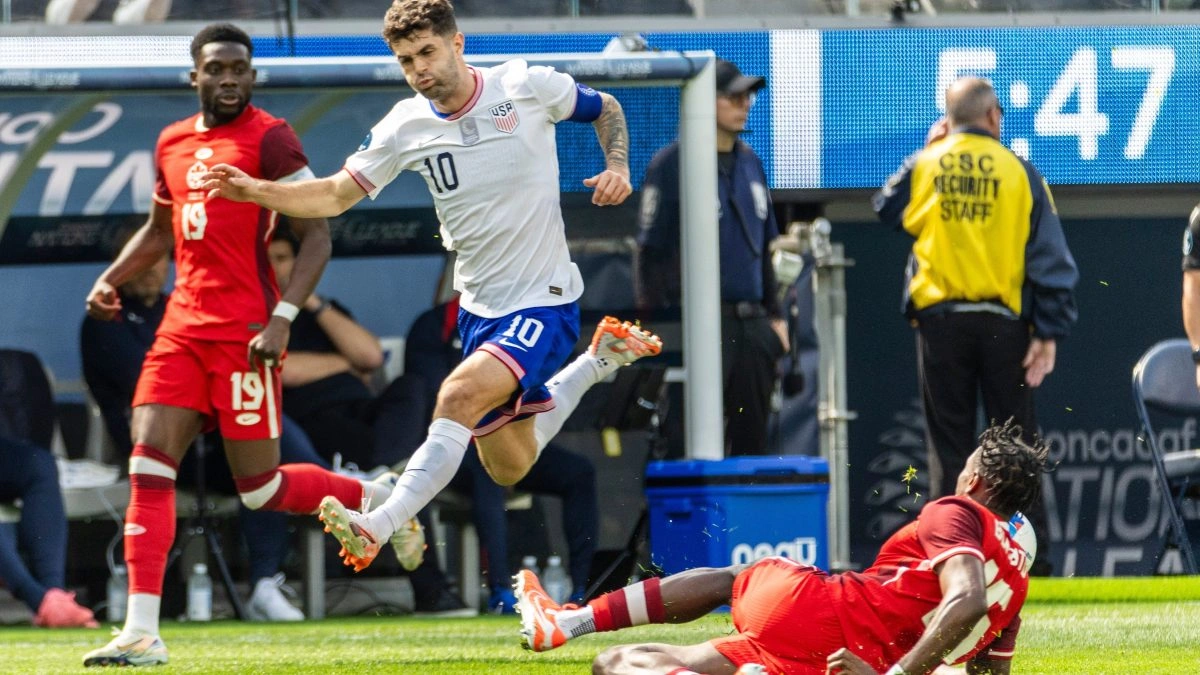
Christian Pulisic didn’t need a long runway in Turin. He needed minutes. Coming off the bench against Torino on Dec. 8, he scored twice in a 10-minute burst that completed a 3–2 comeback and lifted AC Milan to the top of Serie A.
It was the kind of cameo that keeps re-centering the same reality. Pulisic is no longer a “promising American” who happens to play in Europe. He’s a deciding player for one of the sport’s historic clubs, in a league that still punishes anyone who drifts through matches.
Through mid-December, his league numbers match the eye test. He has seven goals in Serie A this season, despite a run of starts and substitute appearances. Earlier this fall, he moved past Clint Dempsey for the most goals by a U.S. player in Europe’s top five leagues, a milestone that matters because it measures longevity at the sport’s highest weekly level.
If the conversation stopped there, his résumé would already be strong enough to claim a place in the U.S. men’s soccer story. The harder question is the one that decides icon status in the United States. Can he turn being the country’s best active player into being the country’s most enduring men’s soccer name?
The timing is obvious. The United States is a 2026 co-host and automatically qualified, and the tournament will be played across the U.S., Canada, and Mexico, with the final set for MetLife Stadium in New Jersey. The World Cup 2026 draw placed the U.S. in a group with Paraguay, Australia, and a UEFA playoff winner. That’s not a guarantee of anything, but it does create a clear stage for a star-making run.
What his icon case hinges on in 2026
Start with the math, because it clarifies the task. Pulisic is already deep in the program’s record book with 32 U.S. goals and 19 assists, but Landon Donovan and Dempsey are still tied on 57 goals. The gap is large enough that 2026 is unlikely to be judged by totals alone. It will be judged by leverage, the moments that decide tournament games.
Leverage is the difference between “best player” and “defining player.” It’s the goal that sends you through, the sequence that turns a knockout match, the performance that makes a tournament’s storyline impossible to tell without you. Pulisic has been in that territory before. He won the UEFA Champions League with Chelsea, and he scored the U.S. winner against Iran at the 2022 World Cup to put the team into the round of 16. Those are the entries that separate careers with highlights from careers with historical markers.
He also has a unique U.S. Soccer footprint for his era. In 2024, he was named U.S. Soccer Male Player of the Year for the fourth time, tying Donovan for the most. Awards don’t settle “greatest” debates, but they do show how long he has carried the responsibility that comes with being the face of the team.
The missing piece is the home-tournament signature. A co-host World Cup offers something American men’s soccer almost never gets: a sustained stretch where the national team is the main product, in domestic stadiums, on domestic time. If Pulisic carries his Milan level into that environment and delivers at least one defining moment in a game that matters, the legacy conversation changes in a way club form alone can’t replicate.
There’s also a non-soccer pressure point he created for himself. In 2024, after scoring for the U.S., Pulisic used a goal celebration that he later acknowledged was associated with Donald Trump, and he explained it was intended as humor rather than a political statement. The detail matters less than what it illustrates. When you’re the national-team star in a polarized country, even small gestures can become part of the public narrative around you.
That’s why the simplest version of Pulisic’s 2026 plan is also the hardest. Control what can be controlled. Arrive healthy. Play like the Milan version of himself. Then do the one thing that turns a star into an icon in the U.S., deliver when the tournament tightens and the margin shrinks.
A World Cup on home soil won’t automatically make him a permanent American sports figure. But it will give him the cleanest conditions any U.S. men’s player has had to become one. If he takes it, the Donovan and Dempsey era won’t be the last reference point. It will be the bar he cleared, and the one the next generation has to chase.
