

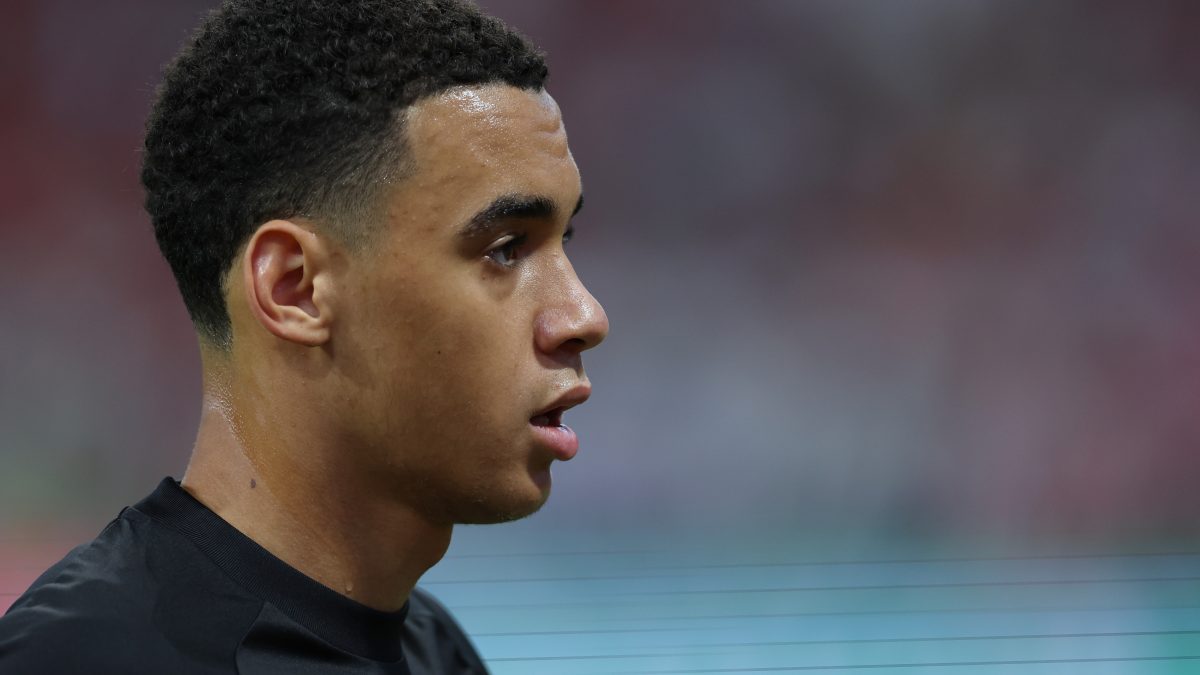
Jamal Musiala is back on the grass at Bayern Munich.
After a six-month recovery from a fibula fracture tied to a broken and dislocated ankle suffered at the Club World Cup, Bayern confirmed the 22-year-old has returned to parts of team training. The session was controlled, warm-ups and passing drills, then back to individual rehab.
Now it’s time for the youngster to rebuild back to his best. Yet, there’s a big difference between returning and returning to form.
Bayern’s target is simple: get Musiala minutes again in January, then scale his workload without forcing the timeline. The bigger question is what that schedule means for Germany and the 2026 World Cup, which begins in mid-June. That runway is longer than it sounds, but it also comes with a catch. A player can be medically cleared and still be a few months away from the sharpness that makes them special.
Return to play is not return to performance
Musiala’s game is built on small advantages. A half-turn between lines. A burst into space. A change of pace that turns a safe possession into a chance. Those are the last things to fully come back after a long ankle injury because they depend on confidence, rhythm, and repeated high-speed actions, not just fitness.
That is why January should be viewed as the start of phase two, not the finish line.
If Musiala is getting controlled minutes in January, he has roughly five months to rebuild match fitness before the World Cup. In a best-case scenario, the early weeks look like short appearances and carefully managed training load. February becomes the month where Bayern begin to trust him in more demanding game states. By late March and April, the goal is simple: string together weeks of normal football, not rehab football.
What Germany needs from him in 2026
If the ramp-up goes smoothly, Musiala’s value for Germany is obvious. He is the kind of player who can carry attacks through pressure, connect midfield to the front line, and create chances in tight spaces where World Cup matches are often decided.
Germany do not need him to be a miracle worker in June. They need him to be reliable. Fit enough to play multiple high-intensity matches in a short stretch. Sharp enough to take responsibility in the final third. Confident enough to accelerate into duels without hesitation.
The good news is that the calendar gives him a real shot at that. The bad news is that the next two months will tell the story. January minutes are the headline, but March and April rhythm is the actual predictor of how big his World Cup role can be.
The comeback is underway. Now we see how quickly Musiala can become Musiala again.
