

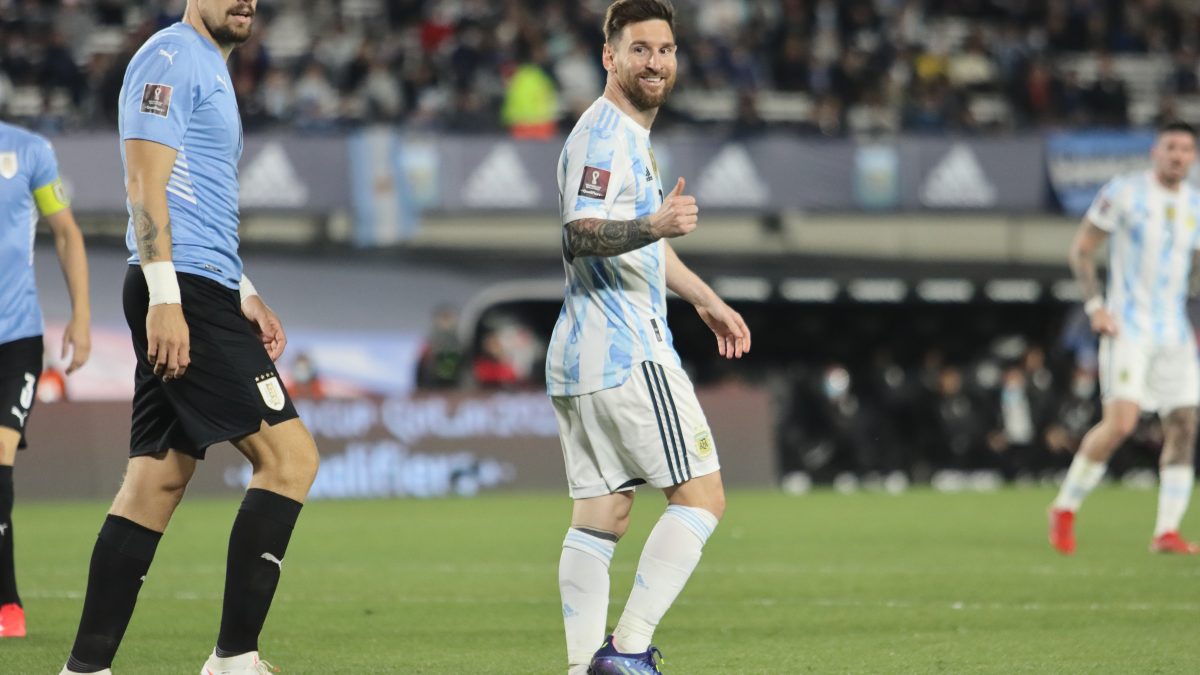
Will he or won’t he play at the 2026 World Cup? The question hangs over Argentina’s title defense as heavily as the draw itself. The tournament is coming to North America either way. What nobody can answer is whether Lionel Messi will be on the pitch or watching from the stands.
In his latest interview, Messi nudged the conversation forward without closing it. Asked again about his plans, he said, “I hope I can be there. I’ve said before that I’d love to be there. At worst, I’ll be there watching it live.”
Classic 2025 Messi. Clear enough to get people dreaming. Careful enough to remind everyone nothing is guaranteed.
A year ago he still talked about Qatar as the perfect ending. Now he’s openly leaving the door ajar for a record sixth World Cup—something fans romanticize as a “real last dance” even as others quietly admit they’d rather see him walk away on top.
Lionel Scaloni has tried to calm the noise while keeping every option on the table. The Argentina coach says “the door will always be open” if Messi wants to keep going, and he keeps repeating a simple message in public: “We need to leave him alone and let him decide.”
At the same time, Scaloni has pointed out that the national team can win without its number 10 now—a shift underlined by qualifying victories over Uruguay and Brazil while Messi sat in street clothes.
Other voices have surfaced too. Luis Suárez already said his friend still has a “desire” to be there, the clearest hint yet from someone who actually shares a dressing room with Messi, not just a timeline.
Argentina are qualified. The calendar is set. World Cup 2026 is no longer some abstract idea but a tournament with cities, venues, and soon, opponents.
Three ways Argentina could use Messi in 2026
Strip away the emotion and the question isn’t just yes or no. It’s how. What version of Argentina makes sense for a 39-year-old Messi who has already won everything? And what version of Messi makes sense for a team that has learned to function without him?
The first scenario is easiest to picture. Messi starts—but the team is built to shield him. Watch any Inter Miami game and you see how it works: he drifts into space between the lines, waits for the ball, and lets everyone else do the running. For Argentina, that means a 4-2-3-1 or 4-3-3 with Messi floating as a free 10, Julián Álvarez or Lautaro Martínez running the line, and a winger like Alejandro Garnacho stretching the pitch.
Behind him, the midfield would cover the ground he no longer can. Rodrigo De Paul and a partner—Alexis Mac Allister or Enzo Fernández—can handle transitions and the ugly work, letting Argentina accept his defensive trade-off in exchange for his ability to solve games with one pass or touch.
The problem isn’t structure. It’s schedule. A 48-team World Cup means more games, more travel across a massive continent, and a tournament played in summer heat—on artificial turf in some venues. Expecting Messi to start every group match and then carry that load into the knockouts feels like a risk both he and Scaloni know too well after the injuries that have already interrupted his time in Miami.
The second scenario is less romantic, maybe more ruthless. Messi doesn’t start. He finishes. Argentina send out the kids, let them press and run for sixty minutes. Then Messi strolls off the bench when legs are heavy and the game is there to be won. He becomes a specialist for the final 25 or 30 minutes—the player who either unlocks a low block or helps Argentina keep the ball when they’re trying to see out a lead.
A growing section of fans like the idea. It feels modern. It respects the fact that he can’t play ninety intense minutes every three or four days. It also asks a lot of ego from a player who has been first on the teamsheet since his teens.
The good news for Scaloni: the groundwork is already there. He’s used Messi off the bench in qualifiers, openly framed some games as chances to test new talent, and talked about the need to monitor his captain’s fitness closely.
A third option sits between those two—and might be the most realistic. Messi starts some matches, closes others, and becomes a permanent presence around the squad even when he’s not on the pitch. In the same interview, he explained how often he talks with Scaloni about what comes next, and relayed one line from his coach that stood out: “He always tells me that he would like me to be there in any role.”
That “any role” is where things get interesting. It covers the obvious football versions—starter or super sub—but also hints at something more informal. Messi can sit in video sessions with younger attackers, talk them through pressure he’s already lived, and act as the bridge between a generation that suffered through near misses and one that has only ever known Argentina as world champions.
The country has seen this before with Diego Maradona on the touchline in 2010. The difference: Messi would walk into a far more stable project.
It’s easy to forget, because so much of the debate still gets framed like it’s 2014, that this Argentina is built to win without being structurally dependent on Messi. Scaloni has said as much. Results without him—and the rise of players ready to carry more responsibility—back that up.
Fans want to believe he can just decide to play a sixth World Cup and that’s that. The people around him know better. Messi will ask himself harder questions—can his body hold up, can he still change games, can he survive a full MLS season and then show up ready for the knockouts?
The rest of us will keep refreshing the same question: will he or won’t he play?
For now his answer is simple enough. He hopes he can be there. The final call arrives when his legs and his heart agree on the same thing.
