

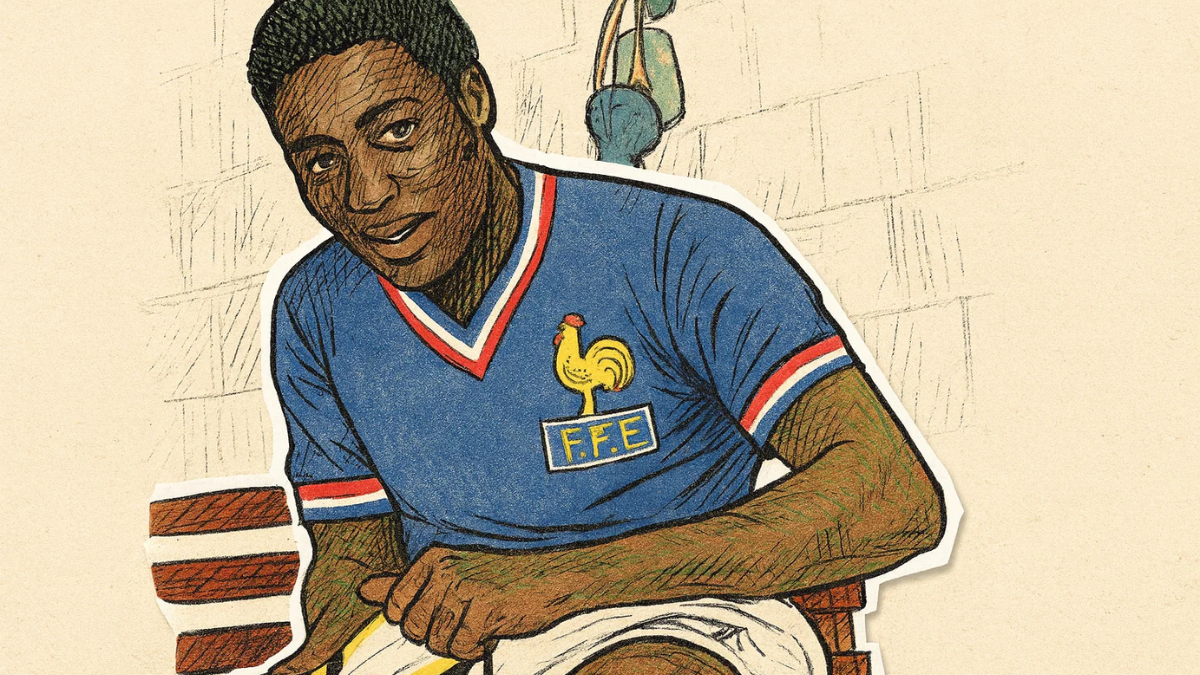
For almost four decades, the routine of Bernadette Adams hardly changed. She opened the shutters in their house outside Nîmes, turned on the television and walked over to the hospital bed in the living room. She washed the man lying there, shaved him, stretched his stiff limbs and fed him spoonfuls of blended food. Then she sat nearby and let the sound of football fill the room, talking to her husband just in case some part of him was still picking it up.
Once, Jean-Pierre Adams had been one of the brightest defenders in France. Born in Dakar and raised in central France, he fought his way up from amateur sides to Nîmes, Nice and Paris Saint-Germain, collecting 22 caps for the national team in the 1970s. With Marius Trésor he formed the celebrated central partnership nicknamed “La garde noire”, the black guard at the heart of Les Bleus.
By the start of the 1980s his playing career was winding down. Adams moved into coaching, still fit enough to jump into drills and still recognizable in the stands at grounds where he had once been a star. In March 1982, while attending a coaching course in Dijon, he suffered a ligament injury in his knee. It was the sort of problem footballers are told can be tidied up quickly. A short stay in hospital, a routine clean-up, then back to work.
Doctors scheduled surgery in Lyon. On paper it looked simple enough, the kind of operation players book between fixtures without thinking too much about it. Adams checked into the Édouard Herriot Hospital on 17 March expecting inconvenience, not danger. What followed would turn a standard procedure into one of the most heartbreaking stories the game has ever produced.
When routine surgery goes wrong
That day the hospital was running on reduced staff because of a strike. The anesthetist on duty was exhausted, covering more cases than usual, and a trainee was involved in Adams’ care. During the operation, a series of errors led to Adams suffering a bronchospasm. His airway closed, his brain was starved of oxygen and he slipped into a coma he would never leave.
Anesthesiologists tend to explain risk with numbers. In big European hospitals you might go through a hundred thousand operations before a patient dies purely because of the anesthetic. Lasting brain damage is rarer still. For most players, the pattern is familiar: the operation, the rehab grind, the comeback interview.
Adams was the exception, the man who slipped into that tiny space between reassuring statistics and reality.
He spent months in hospital, alive but utterly dependent, drifting somewhere between sleep and silence. As the weeks became years, a French court eventually found the anesthetist and trainee guilty of involuntary injury and handed down suspended sentences and fines. The paperwork recorded fault. It could not give a husband and father his life back.
What did change the story was Bernadette’s decision to bring him home. After seeing him develop bedsores and infections in hospital, she decided that if he was going to remain in this limbo he would do it surrounded by family, not fluorescent lights. With help from the French federation and his former clubs, she oversaw the construction of a single-story house outside Nîmes that she named Mas du bel athlète dormant, the House of the Beautiful Sleeping Athlete.
Inside that house, a different kind of football story unfolded.
Bernadette became nurse, physiotherapist and guardian. She fed him several times a day, carefully lifting spoon after spoon of blended food to his mouth, often spending hours on a single meal. She learned how to stretch his arms and legs so his muscles would not seize completely. Birthdays were still celebrated, cakes still bought, candles still blown out by their sons Laurent and Frédéric. Every year they wrapped new long-sleeved shirts for him, the only clothing he really needed.
The cost, emotional and practical, was immense. Friends drifted away. Money was tight. Bernadette mostly stopped attending her children’s events because she could not bear to leave Jean-Pierre alone for long. For a few hours once a week, when he was stable, she allowed herself a small escape to a local dance. Then she came home, back to the man who had not spoken to her since 1982.
She refused to consider ending his life. She would not even let newspapers photograph him in his bed, insisting that the public remember the strong defender in blue, not a motionless body surrounded by machines. To her he was still there, even if medicine could not prove it. For 39 years, their house was a private shrine to a career cut short and a marriage that refused to end.
The risk behind the treatment
At the top of the game now, operations are almost background noise: keyhole clean-ups, ACL repairs, hip and groin surgeries. Medical staff swap notes about return dates, training loads and GPS data. Everybody knows there is some danger, but most of the time the gamble pays off and the player comes back.
Those odds really are stacked in a player’s favor. In a major European hospital you could watch tens of thousands of anesthetics without seeing one end in death caused solely by the drugs; permanent brain injury is rarer again. It is easy to forget that “routine” never quite means “risk-free.”
In 1982, that small risk collided with overworked staff and poor monitoring and produced a nightmare outcome. The defender who had once marked Gerd Müller and led back lines in Ligue 1 never woke up from what was supposed to be a straightforward operation on his knee.
How football remembered him
Adams died in Nîmes on 6 September 2021, aged 73. The following night, in Lyon, the city where he had once gone under the knife, France played Finland in a World Cup qualifier. Before kick-off the stadium rose in a minute of applause, a public acknowledgement of the quiet devotion that had unfolded far from the cameras.
In the tributes, he was remembered as a powerful center-back, a pioneer among Black French players and a partner to Trésor in a national team that helped pave the way for the multicolored France that would later lift the World Cup. His former clubs honored him. The city of Nîmes later renamed a local sports complex in his honor. Fans who had barely seen him play discovered his story, often through the prism of Bernadette’s loyalty.
Adams is more than a sad footnote from another era. His life runs from Dakar playgrounds to packed French stadiums.
Football will keep producing new center-backs, new idols, and fresh shirts to sell. What it is unlikely to produce again is a story like the House of the Beautiful Sleeping Athlete, or another spouse prepared to sit by a bed for nearly forty seasons while the rest of the game moved on.
