

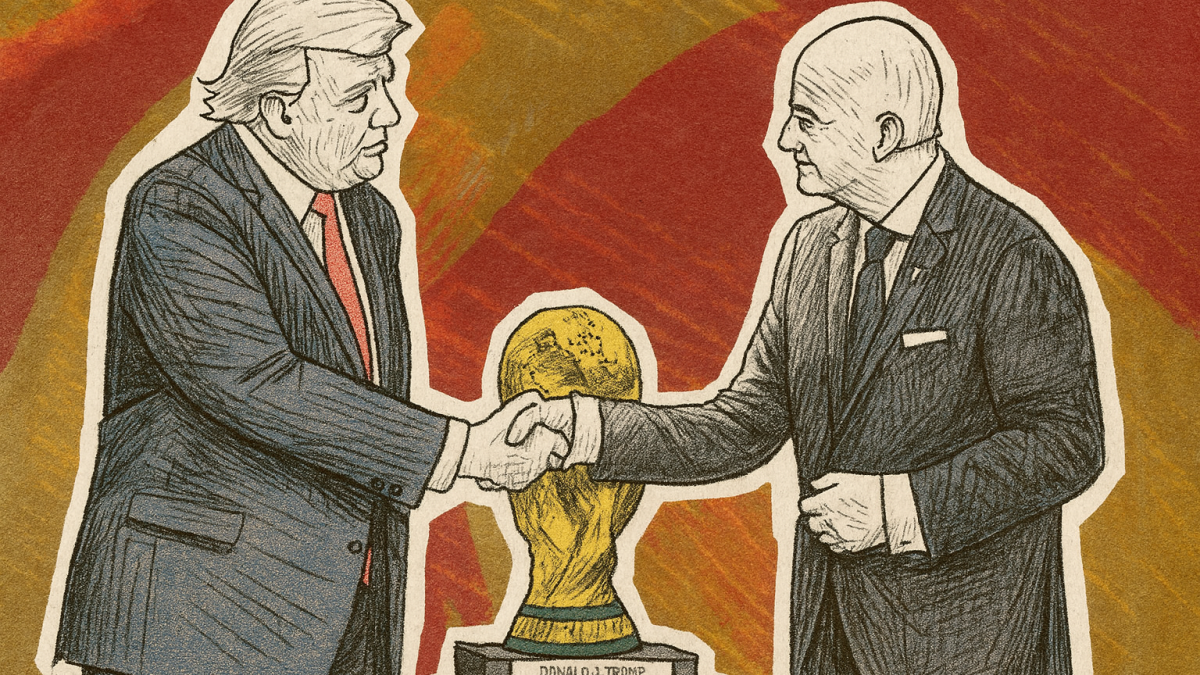
The setting told you everything. A gold sculpture of hands clutching a globe. The Kennedy Center. And Donald Trump at center stage, receiving FIFA’s first-ever peace prize while Gianni Infantino called him a “close friend” and praised his “exceptional and extraordinary actions to promote peace and unity around the world.” Trump accepted a trophy, a medal, a certificate. He told the crowd this ranked among the “great things” in his life.
He went bigger from there. “We saved millions and millions of lives,” he said, rattling off regions from Congo to India and Pakistan. He praised Infantino for “setting new records on ticket sales” and predicted the 2026 World Cup would be “an event the likes of which maybe the world has never seen.” The draw itself? Suddenly felt like the opening act.
Online, the reaction ranged from disbelief to dark comedy. FIFA had introduced a prize with no public criteria. It awarded that prize to a sitting president known for aggressive political branding. It staged the whole thing in a venue more associated with statecraft than sport. And the occasion wasn’t a humanitarian milestone or a football crisis—it was the draw for a tournament that will define FIFA’s commercial future for the next decade.
A prize nobody voted on
FIFA hasn’t explained how the prize came to exist or how Trump was chosen. The Athletic reported that the governing body’s 37-member Council wasn’t consulted. Its 211-member Congress never voted on criteria or a winner. Human Rights Watch said FIFA wouldn’t answer basic questions about nominations or eligibility—leading them to conclude that no transparent process existed at all. The whole thing had the feeling of an award invented for the recipient.
The timing only made that impression worse. Trump and his allies had pushed hard for a Nobel nomination earlier this year, before the award went to Venezuelan opposition leader María Corina Machado. Senior Republicans called the decision political and vowed to rally support for Trump next cycle. Weeks later, FIFA unveiled a brand-new honor celebrating peace. Coincidence? Almost nobody bought it.
The ceremony drove the point home. After accepting the prize, Trump stood alongside Mexican president Claudia Sheinbaum and Canadian prime minister Mark Carney like it was a trilateral summit. He mentioned he’d be meeting both leaders later that day. The event closed with the Village People performing “Y.M.C.A.”—a fixture at Trump rallies. Football ceremony or campaign event? Hard to tell.
The transaction underneath the spectacle
Trump and Infantino have been showing up together at international events all year. Their partnership has grown more visible as preparations ramp up for the expanded 2026 World Cup, co-hosted by the United States, Canada, and Mexico. Infantino recently said it was “crucial” for FIFA to maintain a close relationship with the U.S. president. FIFA also appointed Ivanka Trump to the board of a $100 million education initiative funded partly by 2026 ticket revenues. The organization frames these moves as promoting global unity. Others might use different language.
Meanwhile, Trump’s claims of peacemaking don’t hold up well under scrutiny. The Gaza conflict continues, if at reduced intensity. The Israel-Iran clash included U.S. participation through long-range airstrikes. India flatly dismissed Trump’s suggestion that he eased tensions with Pakistan earlier this year. His statements on Serbia and Kosovo, on Egypt and Ethiopia, don’t match conditions on the ground. His use of force in the Caribbean has drawn significant criticism. None of this came up during the award presentation. The ceremony ran on Trump’s narrative alone.
But the logic isn’t hard to follow. The 2026 World Cup will feature a record 104 matches across 16 cities—the largest sporting event ever organized. The U.S. market will drive most of its commercial value. FIFA wants the tournament wrapped in themes of unity, stability, and North American cooperation. Trump wants a global stage that doesn’t care about his domestic baggage. FIFA can give him one. The peace prize is the handshake.
Online, people noticed the obvious. A prize that didn’t exist six months ago. An organization that still can’t shake corruption headlines. A recipient whose foreign policy record ranges from disputed to actively contested. The whole thing had the subtlety of a campaign ad—and the internet treated it like one.
What this tells us about 2026
Nobody watching the ceremony expected it to reshape geopolitics. That wasn’t the point. FIFA showed it’s willing to blur the line between football and political theater—and it’s not embarrassed about it. Trump isn’t just a host-country president in this framing. He’s a character in FIFA’s promotional story, positioned as a peacemaker whether or not the record supports it.
Trump gets the international stage he’s been chasing. Infantino gets a grateful ally running the country that will drive most of the tournament’s revenue. The rest of us get a preview: this World Cup will be loud, politically charged, and impossible to separate from the people behind it.
Friday made that clear. The biggest tournament in history is coming—and it’s bringing the campaign rally energy with it.
